
How to Avoid Overbooking on Rental Equipment
You rented out the same bike to two different people for the same Saturday morning. Or the bounce house you promised for a 3pm party doesn't actually come back until 4:30 from another event. It's happened, or it's come close enough — and you know the item itself was never the problem. It's not having an instant, absolute answer to what's actually free and what isn't.
When tracking is done on paper, in a spreadsheet, or from memory, that's not carelessness — it's just math. At some point there are too many bookings, too many items, and too many back-and-forth messages to cross-check it all without a mistake slipping through. And the mistake always shows up at the worst possible moment: when the customer is already standing at your door.
Why overbooking happens even to people who are careful
You don't need to be sloppy to double-book something. Someone messages on WhatsApp at 10am, you confirm it in your head, and at 10:15 someone else calls asking about the same item for the same day. If the notebook isn't right in front of you at that exact second — or you forget to write it down straight away — that's it. Two bookings, one unit.
The problem grows with the business. The more items you have, the more customers, the more channels (phone, WhatsApp, Instagram, walk-ins), the higher the odds that two people book the same thing without anyone noticing in time.
What changes with real stock control
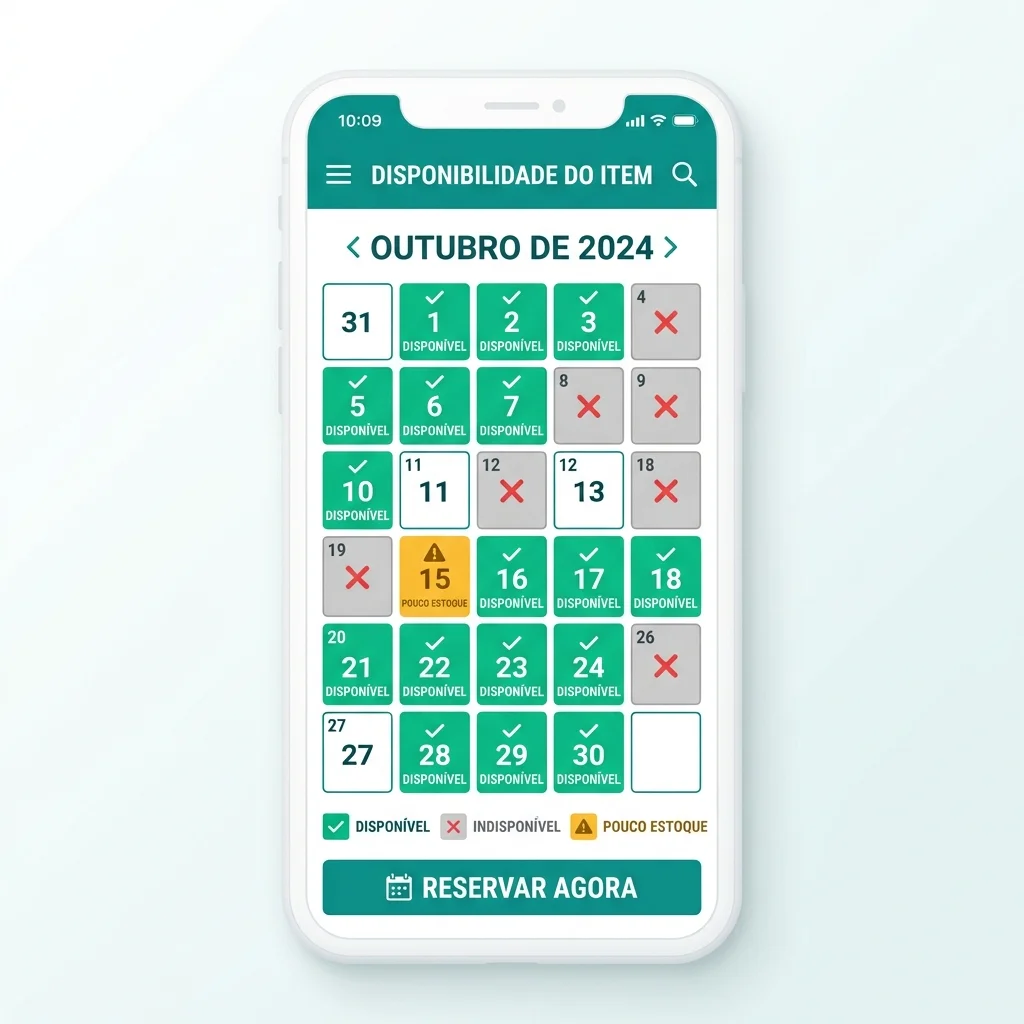
With Marca lá, every rental item has a set number of units — not "I've got roughly 5 bikes", but exactly 5, and the system knows exactly how many are free for any given period. When a customer books, the public calendar already shows whether that item is available, with a warning when only a few units remain, and blocked in red once stock for that period hits zero.
The part that actually prevents double-booking happens at the exact moment of the booking: even if two customers are trying to reserve the same item at the same time, the system re-checks real availability the instant the booking is submitted — it doesn't just trust what the screen showed a minute earlier. If the units are no longer available, the customer is told right there and has to pick a different period, instead of the booking going through and you finding out about the conflict hours later.
This works whether the item is priced by the hour (one bike in the morning, another customer in the afternoon) or by the day (event equipment booked weeks in advance) — the stock logic adapts to each item's price type.
What if someone needs to cancel?
Cancellations happen, and an item that got "occupied" by mistake shouldn't keep blocking your calendar. When a booking is cancelled, the unit automatically counts as available again for that period — you don't need to go and manually free it up.
It's not just about avoiding mistakes — it's about not wasting time checking
The real win isn't just "I'll never have a double-booking again." It's not having to double-check things in your head, ask yourself "wait, didn't I already rent this out to someone?", or keep a parallel spreadsheet just to be sure. The system knows what's free — you just have to look.
If rentals are your business (or part of it), it's worth having this sorted from day one, instead of putting out fires every time two bookings collide.