Table Reservations and Takeaway in One Place — Why Bring Them Together
The reservations notebook sits at the front desk. The takeaway WhatsApp lives on someone's phone in the kitchen. And sometimes, in the middle of a busy Friday dinner, those two sources of information never actually reach the person serving the tables — which means sooner or later someone's going to ask "who was supposed to handle this?" and the answer will be a shrug.
It's not a lack of organization. It's that table reservations and takeaway orders are, in practice, two different businesses running at the same time, in the same space, with the same people — and there's rarely a tool built to handle both together.
The problem with two workflows that don't talk to each other
When reservations live in a notebook and takeaway lives in a chat, nobody has a full picture of the day. You can't tell at a glance whether the night is going to be fully booked on top of a queue of pickup orders — which completely changes how you staff the kitchen.
Then there's the invisible work: confirming every reservation by hand, remembering to tell the customer their table is ready, or that their order is ready for pickup. All of this is doable manually — it just eats up time that, on a busy shift, simply isn't there.
What it looks like when both live in the same panel
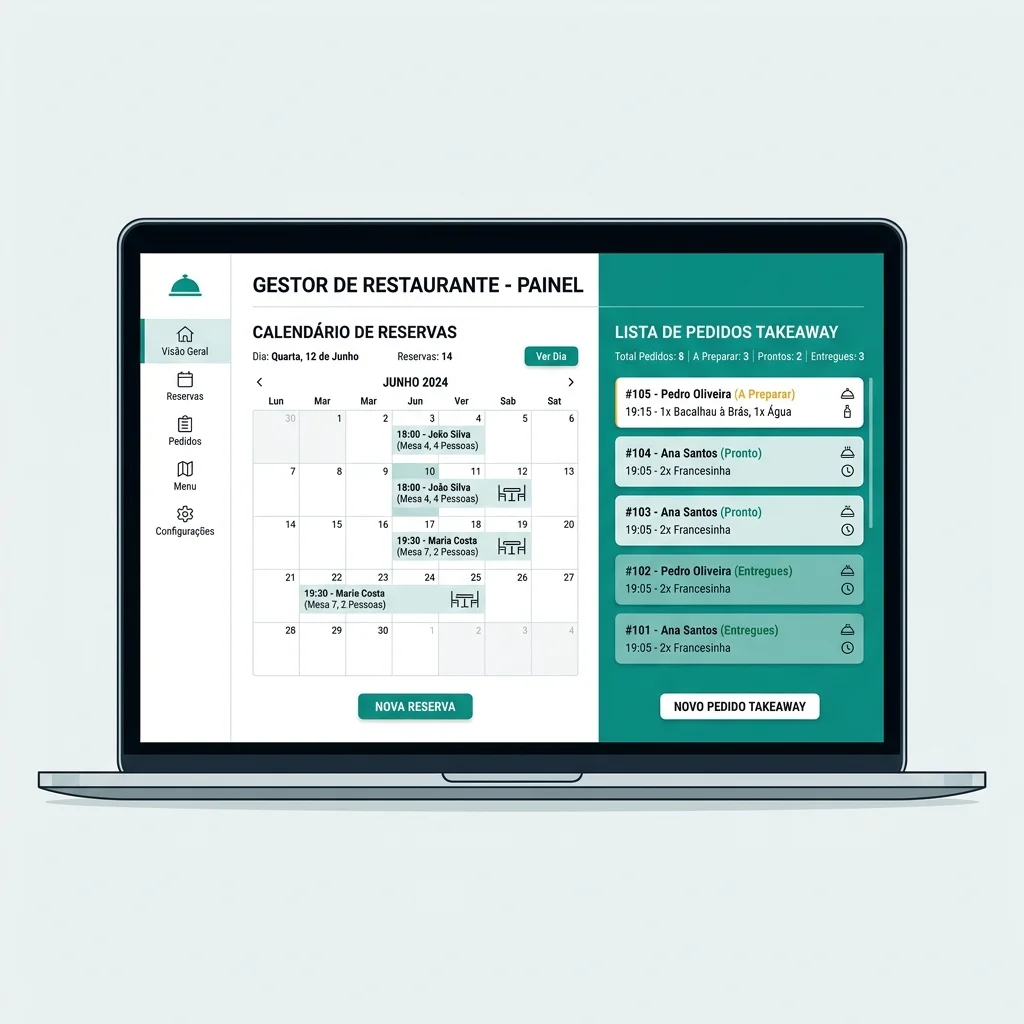
With Marca lá, table reservations and takeaway orders are managed in the same place, backed by the same client directory — not two systems bolted together. You can turn on just reservations, just takeaway, or both, depending on what your restaurant actually offers.
For reservations, the customer books a table straight from your page, picks the number of people and the time, and you decide whether each reservation needs your manual confirmation or gets confirmed automatically — for a dining room with little back-and-forth on decisions, this saves an enormous amount of hassle. And since the reservation reminder is sent just 1 hour ahead (instead of the typical 24 hours for a service booking), it fits how most people actually decide on dinner — last minute.
For takeaway, the customer orders from the menu, and the order is always available for pickup at the counter; delivery only shows up as an option if you've set up your own courier — it's never assumed by default. As the order moves forward (confirmed, ready, on the way), the customer gets an automatic notification, so nobody has to manually type "it's ready" to every single person.
One thing Marca lá deliberately doesn't do
The platform doesn't process or handle payment for any reservation or order — that stays entirely in your hands, just like today, whether it's cash, card terminal, or your own invoicing system. What Marca lá organizes is the "who, when, and how many" — the money always passes through your hands, not ours.
What you gain by having it all together
It's not just about convenience. It's not having to check two different places to know how the night is shaping up, and not having to trust that someone will remember to notify the customer at the right time. The notebook and WhatsApp still work — it's just that past a certain size, they end up costing you more time than they save.